
Where did “writing icons” come from, and why language shapes what we believe about sacred art
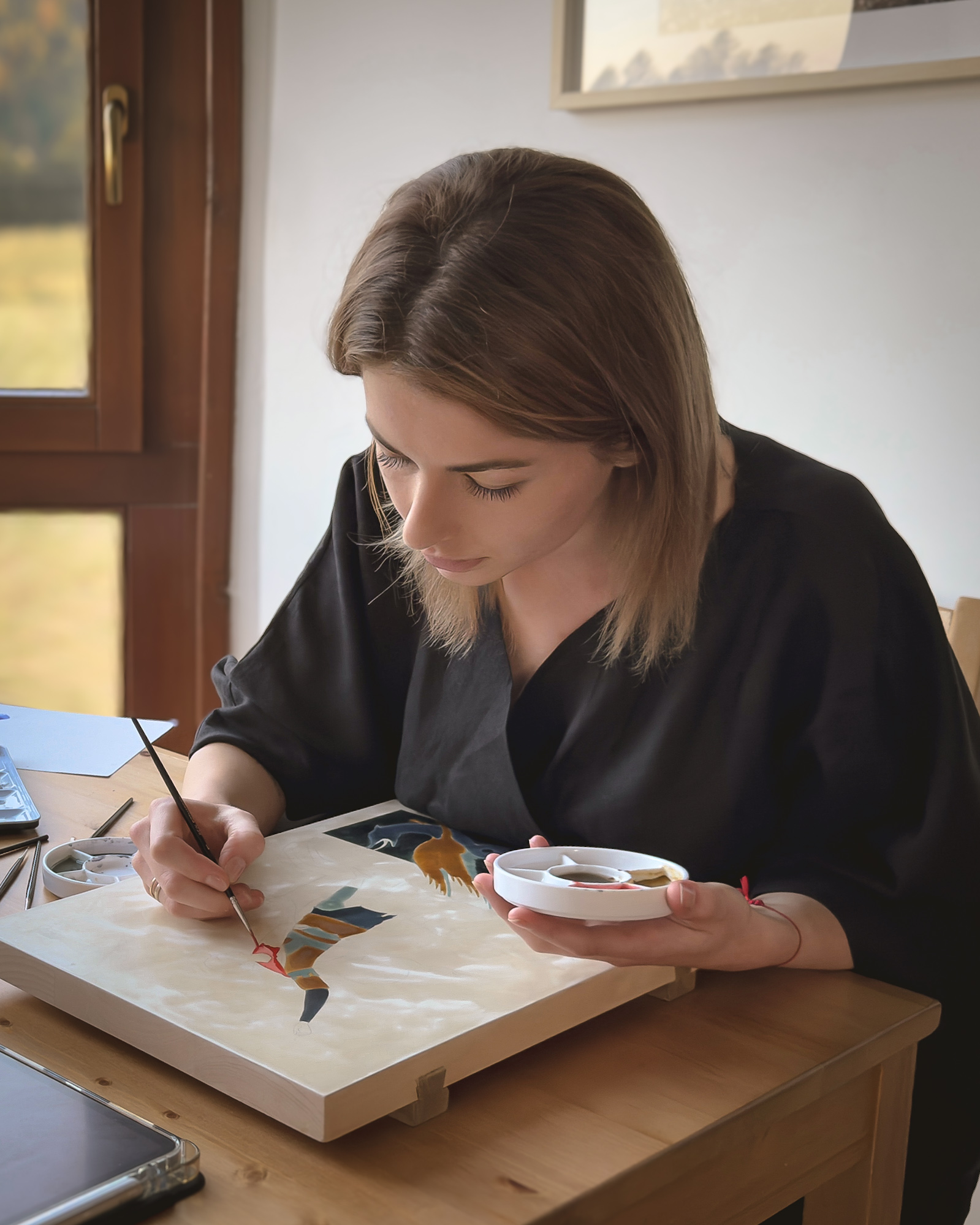
When I tell people that my passion is painting icons, I am often met with surprise. I hear a note of bewilderment and questions about why I don’t “write” icons. I get the impression that the word “write” alone lends some mystical quality to my work, while the word “paint” somehow makes the icon less sacred. Could a single word truly have the power to transform secular art into sacred art?
This question has stayed with me for years. As an iconographer working in egg tempera, I engage daily with matter, pigment, and gold. I know that the process of creating an icon is deeply physical and at the same time contemplative. But does the name we give this process really change its essence?
Greek roots, or where it all began
I am not a linguist, but I will try to shed light on this topic by comparing the languages of neighbouring cultures where the tradition of iconography stretches back centuries.
The expression “writing icons” gained popularity especially within the circles of the Russian Orthodox Church. This terminological peculiarity stems from the Russian and Greek languages, in which the words for “to write” and “to paint” share common roots and can be used interchangeably.
The iconography of medieval Greece had an enormous influence on the development of this art in the territories of Kyivan Rus, and the terminology travelled along with it.
In Greek, the word “γράφω” (gráfo̱) carries a dual meaning, referring both to “writing” and to “painting.” A more precise term for artistic painting is ζωγραφίζω (zo̱grafízo̱). For utilitarian painting (such as painting the walls of a house), the word βάφω (váfo̱) is used, which also means “to paint.”
The word ζωγράφος (zo̱gráfos) means “painter.” Meanwhile, συγγραφέας (syngraféas) means “writer,” εικονογράφος (eikonográfos) refers to an “illustrator,” and αγιογράφος (agiográfos) to a “hagiographer,” that is, a person who paints saints, known in Russian as “ikonopisets” (Rus. иконописец).
This dual sense of the Greek “γράφω” is the key to understanding the entire terminological confusion. When the Byzantine tradition reached the lands of Rus, the word travelled together with technique and theology, but its double meaning was not always legible in the target languages.
What do the dictionaries say? A comparison across languages
Let us look at how dictionaries in different languages define the word “to write” and whether it truly encompasses the creation of painted works.
In the Russian dictionary, the word “писа́ть” (pisat) is defined as follows:
1. “to represent on paper or other material signs of some kind (letters, numbers, etc.)”
2. “to record text in writing”
3.”to inform about something through writing or print”
4. “to compose or create something containing words”
5. “to compose or create a musical work”
6. “to create a work of (visual) art”
In the Ukrainian dictionary, the word “писати” (pysaty) means:
1. “to represent graphic signs (letters, numbers, etc.) by hand on paper”
2. “to inform about something through writing or print”
3. “to edit and record text”
4. “to engage in literary activity, to be a writer”
5. “to create a painted work of art”
6. “to assign someone a name or surname by noting it in a document”
The Polish dictionary explains the meaning of the word “pisać” in the following way:
1. “to trace graphic signs on paper or other material by hand, or to print them by means of a machine, in order to express something”
2. “to create something in writing, usually for publication”
3. “to formulate one’s thoughts in writing”
4. “to communicate something in writing”
5. (archaic) “to decorate with drawings, patterns, etc.”
Comparing the Polish word “pisać” with its Greek, Russian, and Ukrainian counterparts, we see a significant difference in how it is applied to the description of artistic creation. In Russian and Ukrainian, “to write” naturally encompasses the creation of images. In Polish, this meaning is virtually absent, and the only related usage is marked as archaic.
Where did the Polish word for “painting” come from?
In the Polish language, from the sixteenth century onward, the German word “malen” gained popularity, giving rise to the verb “malować” (to paint). According to the PWN dictionary, it means:
1. “to cover something with paint or varnish”
2. “to represent something on paper, canvas, etc. by means of drawing and paints”
3. “to apply makeup”
4. «”to describe or portray something or someone vividly, colourfully”
This word later also entered the Ukrainian language and has been in common use there since approximately the twentieth century. As a result, both languages now have two verbs, “to write” and “to paint,” but their semantic ranges differ depending on the cultural context.
The Ukrainian perspective, or why this is not exclusively a Polish problem
The difficulty with this topic in the realm of sacred art concerns not only artists working in Poland but also those in Ukraine.
As Kostko Markovych observes in his article entitled “An Icon Written or Painted?”:
There is a significant difference in the connotation of the word “to paint” between Ukrainian (“малювати” — “maliuvaty”) and Russian (“малевать” — “malevat”). The Russian word “малевать” carries an ironic undertone, referring to unskilled painting. For “worthy” art, the words “писать” (pisat), “рисовать” (risovat), “изображать” (izobrazhat) are used.
Markovych also notes that the term “to write icons” spread through church circles, particularly under the influence of the Orthodox Church of the Moscow Patriarchate, so effectively that the Greek Catholic Church also adopted it.
What is especially significant from a practitioner’s perspective is Markovych’s observation that the creation of an icon involves many activities that cannot be reduced to a single word, whether “to write” or “to paint.” First comes the drawing, the composition. Then the gold is laid down, the painting begins. The final activity, in a strictly technical sense, is indeed writing, since the names of the depicted figures or the text of the Gospel are inscribed on the icon.
This observation is remarkably apt. Every iconographer knows that the process of creating an icon is multi-layered. It encompasses the preparation of the wooden panel, the application of the ground, the development of the drawing, gilding, the multi-layered painting in egg tempera, and finally the inscriptions. Reducing this complex process to a single word, regardless of which one we choose, is inevitably a simplification.
Markovych also draws attention to a fact that is often overlooked in this discussion. Sacred representations are not only icons painted on panels but also mosaics, reliefs, and stained glass. No one, however, calls any of these techniques “writing.” And yet they serve precisely the same spiritual content.
Markovych’s observation regarding terminological dependence is also worth noting. The closer the ties to the Orthodox Church of the Moscow Patriarchate, the more frequently Ukrainian artists use the word “to write.”
A beautiful translation, but an imprecise one
Examining this question, one may conclude that the term “writing icons” results from an imprecise translation from the Russian and Greek into Polish. In reality, the process of creating icons is closer to painting than to writing, and therefore a more precise term would be “painting icons.” Nevertheless, “writing icons” remains widely used and accepted in Poland.
The term is usually justified in the following way. The subject matter of icons consists of saints, scenes from the Old and New Testaments. The iconographer thus resembles a monk transcribing passages of Holy Scripture. Using the means of painting, they transcribe the content of the Bible onto the icon panel.
This explanation is, of course, beautiful and perhaps even consistent with the theology of the icon. One should bear in mind, however, that it arises not from theology but from an inaccurate translation. Repeating it in good faith does not change the fact that it superimposes a theological interpretation onto a purely linguistic phenomenon.
Sacredness is born in the space between, not in a name
While studying sacred painting at the Lviv National Academy of Arts, we began with anatomy, drawing geometric forms and plaster busts, academic painting of still lifes and live models. Only after mastering these artistic foundations could we begin working on an icon.
That experience taught me something fundamental. The sacredness of an icon does not arise from nomenclature. An icon is a material work of art, and the sacred emerges through the human encounter with an immaterial space that transcends form. The purpose of icons is to facilitate that encounter, to focus our attention on what lies beyond the image, beyond the word, beyond the name.
An icon is a gateway to silence. A space where the mind can come to rest. No word, “to paint” or “to write,” adds to or diminishes this power. Sacredness is born in the space between the one who looks and the image, in that moment when thought gives way to presence.
Toward a new, conscious tradition
The art of painting icons is growing in popularity in Poland with every passing year. New places are emerging where one can learn this art. Throughout the year, numerous iconography courses are organised by Catholic parishes and cultural centres. Perhaps we are witnessing the birth of a new and beautiful tradition, and it matters that it be grounded in truthful and well-reasoned foundations.
The conscious use of language is part of our respect for the tradition we carry forward. This is not about correcting anyone, but about understanding where the words we use come from and what meanings they carry with them.
With this article, I would like to open a discussion within the sacred art community. As I mentioned at the outset, I do not hold linguistic qualifications to present this material as an academic study. Perhaps there is someone who would wish to explore the topic and describe it in a more exhaustive manner. I would be truly glad if this text becomes an impulse for such a conversation.
.
.
.
*Kostko Markovych, a renowned iconographer and associate professor at the Department of Sacred Art, Lviv National Academy of Arts.
Source:
¹ https://pl.glosbe.com/s%C5%82ownik-polsko-grecki/pisa%C4%87
² https://kartaslov.ru/значение-слова/писать
³ https://slovnyk.ua/index.php?swrd=писати
⁴ https://sjp.pwn.pl/slowniki/pisa%C4%87
⁵ https://sjp.pwn.pl/slowniki/malowa%C4%87.html
⁶ https://risu.ua/ikona-napisana-chi-namalovana_n152172
________________________________________
If the art of icon painting resonates with you and you would like to learn more about the creative process, the egg tempera technique, or the possibility of commissioning an icon, I invite you to get in touch through the Anna Kilyk Atelier website.



Leave A Comment